
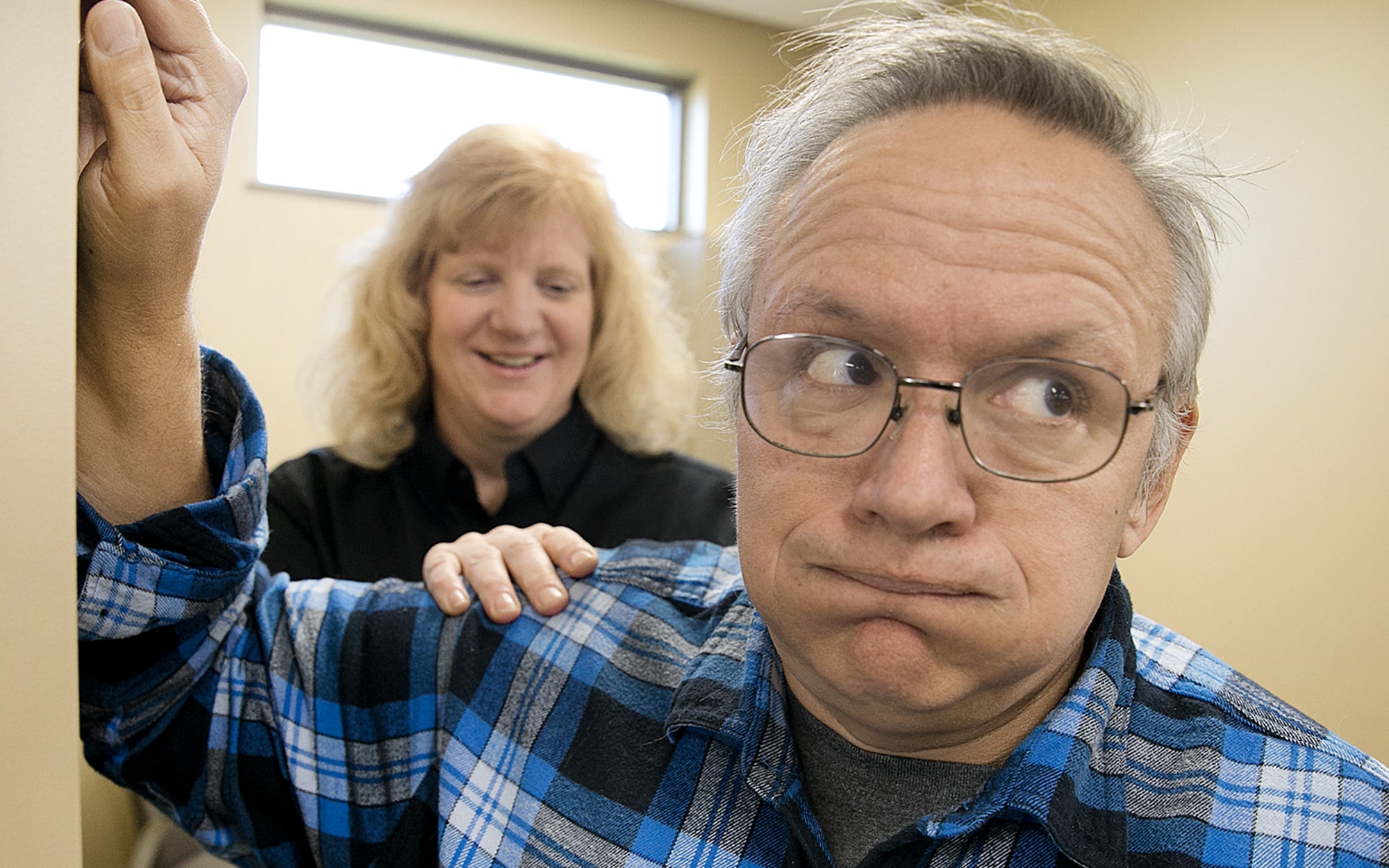
Editor’s Note: Davenport marketing executive, Mike Bawden, is sharing his journey back from a serious injury that has humbled and challenged this go-getter and put on hold his dreams to return to the Boundary Waters along the Minnesota and Canadian border.
The Trail Back: Surviving my “Wiley Coyote Moment”
By Mike Bawden, ORA Orthopedics Physical Therapy Patient
It’s been just over three months since I almost accidentally killed myself.
No. Really.
On Sunday, October 23, 2022, I was working on dismantling an old chainlink fence on our property when my accident occurred. I was on a ladder, disassembling the fence with a Saws-All and bolt cutters.
Because I was using power tools, I decided to wear a safety helmet with ear and eye protection (little did I know how important that would be).
The ladder I grabbed for this job was a lightweight aluminum stepladder – just one of several we have around the house and property. This one was the most convenient to my location, and I didn’t think twice about using it. That was a definite mistake.
I’m a big (too big) guy. And there’s no doubt in my mind that even though I wasn’t standing on the top step of the ladder, my weight was more than the ladder was built to handle – safely – and I paid a pretty severe consequence because of that.
None of that crossed my mind, of course, as I was eight to ten feet up in the air, wrestling with the metal tube that served as the top of the fence. That’s when I felt something shift underneath me.
One of the legs of the stepladder I was standing on collapsed. And in an instant, I was on the ground.
I had suffered a significant injury. Four broken ribs and a punctured lung, along with a shattered scapula. But because I was wearing the helmet, there was no traumatic brain injury – just a headache from when my head snapped back when I landed.
I was so fortunate, in fact, the doctors made it clear to me that had I not been wearing my helmet, they would have been harvesting my organs rather than telling me I was looking at 12 months or more of therapy to regain most of the use of my right arm.
Eight days later, I was out of the hospital and on my own. Or so it seemed.
I needed a team around me.
I was still concerned with how things might go once I left the 24/7 gaze of the various nurses, techs, doctors, and other caregivers who had been such an important part of my life. I met first with my general practitioner to fill him in on my eventful week and promised to keep him in the loop. Next, I followed up with my trauma surgeon, who had put the plates in my back and screwed my ribs together.
But the questions I had – and the concerns that went along with them – related to that “shattered” scapula and just how we were planning on putting Humpty Dumpty (me) back together again.
For that solution, I relied on ORA surgeon Dr. Myles Luszczyk. He introduced himself to me on the second day I was in the hospital. As I explained during that introduction, we had met a few times before – I’ve worked with ORA for years and art-directed photo sessions with Dr. Myles (as he prefers to be called) on a few occasions. I knew he was the right guy for this job, and so I was looking forward to meeting with him a week or so after my discharge.
When I went to ORA for the consultation with the doctor, I was introduced to his Physician’s Assistant, John Tyron. The meeting went well, and John recommended a few movements I could do at home before my first physical therapy appointment with an ORA therapist. The physician, PA, and the physical therapist would work together on creating and managing my recovery.
Sounded good (and easy) in practice. But how would things turn out for real?
When I met Kathryn Ellsworth, a physical therapist and Davenport Clinic Manager at ORA’s location on Northwest Blvd in Davenport, I was curious about whether or not the realities of having all of these services under one roof really met the expectations I had as a patient. What I found surprised even me.
Kathryn had read my file before my arrival. As part of her preparation, she reviewed my x-rays (taken during my visit at ORA) as well as the notes made by both Dr. Myles and John. She also did her own evaluation of my range of motion, muscle strength, and over-all soreness (healing progression).
That first session was more of a “get-to-know-you” session, with Kathryn battering me with questions as she developed a better understanding of my injury and the state of my recovery. She also evaluated my attitude and outlook – and as a part of that conversation, we talked about my goals for recovery.
Some people want to be able to play their favorite sport and get back to doing the things they did before their injury. There was more to it than that for me. I had survived a fall that, by all accounts, could have killed me.
So I wanted the reward of recovery to be worth all the pain that would come with it. For me, there was one place that was so special; I’ve always told myself I had to see it one more time before I checked out for good.
I want to go back to the Quetico/Boundary Waters. Northern Minnesota and Ontario are special places to me – full of memories of friends and my dad. I have a long way to go before I’m in shape to canoe, portage, and pack my way through the wilderness for two weeks.
But that’s the goal. That’s my journey.
That’s the trail back.
You can read more about my journey on my blog.
See you there.
