
Do you feel that chill in the air? No, wait, now it’s 70 degrees again. Hold on, there it is again. That brisk early morning air that sends a shiver up your spine like Old Man Winter is tapping you on the shoulder saying, “Here I come, I’m right around the corner.”
Whelp, I have to be honest. As winter approaches, I’m “that guy” who would rather just have it dump 3-4 feet of snow on the ground and consequently be cold and snowy versus frigid and….and…nothing.
Why? I’m not quite sure but maybe it’s my inner Viking yearning for afternoons of splitting wood against a backdrop of fresh powder, relaxing by a crackling fire, and diving into a bowl of chili. Nah…fantasy over…it’s because with snow brings a lot more outdoor activities my family and I can enjoy rather than just dark arctic weather. Ugghh.
Some of those winter activities we cherish are snow skiing and snowboarding! Now, don’t get me wrong. The anticipation of carving up the slopes also brings with it the realization in my mind that, “Crap, I need to get into snow skiing shape.”
Thus begins the internal battle between the lazy part of my brain which tries to woo itself into thinking my summer water-skiing will carry over into winter downhill snow skiing and the pragmatic part of my brain which exclaims, “Idiot! You’ve been standing on football sidelines all Fall, you’re not in downhill skiing shape!” As I procrastinate more, the urgency becomes greater, and then I’m three or four weeks out from a winter ski trip.
Now what? Well, here’s some tips on exercises to get ready for hitting the slopes from a master procrastinator.

Dr. JC Clark, ORA Orthopedics
First of all, realize that even if you aren’t an Olympic-caliber alpine skier shredding the gnar on double black-diamond runs, snow skiing and snowboarding do require a rudimentary combination of muscular strength, anaerobic power, aerobic endurance, coordination, agility, balance, and flexibility.
Secondly, downhill skiing and snowboarding are very much interval training type of activities. This means bursts of intense activity followed by periods of rest (think strenuous runs down the slope followed by a ski-lift ride up the mountain). Whew! Now, that’s a lot to gain in a few weeks! However, let me simplify it for you and recommend you focus on three things: a solid baseline aerobic capacity, lower body strength, and balance.
In my years as a recreational skier and getting ready to snow ski, I feel that if I focus on those three areas my enjoyment on the slopes is amplified. Thus, as my boys would say, “Bro, stop yapping and tell me what to do!”
1. Baseline Aerobic Capacity
The mixture of cold air, high altitude, and vigorous physical exertion can wreak havoc on your cardiovascular system. If you are traveling to areas with longer ski runs than here in the Midwest, the stress on your heart and lungs can be magnified. Because of this, you will need to have some sort of baseline cardiopulmonary stamina. In an ideal world, you have been doing some aerobic exercise all year long as part of a healthy weekly workout routine. If so and you feel that you have a great aerobic foundation, you can begin to add in some anaerobic activity with interval training workouts. If you haven’t done any aerobic exercise, then pick your favorite aerobic workout (running, swimming, cycling, elliptical, rowing, stair-climber) and start with some medium-paced workouts for 30-40 minutes. Fast enough to get a sweat going but not so strenuous that you can’t speak in full sentences. After a couple weeks of this type of training 3-4 times per week, then you can add in some interval training as discussed below.
Interval training will involve periods of higher intensity exercise followed by periods of rest or lower intensity. For example, if you have been running on a treadmill, you would run for 1-2 minutes at a faster pace and then run for 3 minutes at a slower, more comfortable pace. Doing this for 5 or 6 sets would get you to 30 minutes of cardio. Some people like to do shorter intervals of 10-30 seconds at an all-out maximum pace followed by 30-90 seconds at a more comfortable pace. Either way, the idea is to simulate what downhill skiing would be like from a cardiovascular standpoint: periods of intense activity followed by a period of rest.
If you are just starting to get a solid aerobic base and don’t have time to work in some high intensity interval training, don’t worry. Just obtaining a good aerobic conditioning base will go a long way for providing you the opportunity to enjoy longer ski runs and days on the slopes.
2. Lower Body Strength
Downhill skiing and snowboarding are great workouts for the muscles of the legs. I mean, come on, you are basically in a squat position the whole time. After shredding your quads during the first day on the slopes, they can be so sore on the second day that you can hardly walk. To prevent that second or third day “dead leg” feeling, I often try to ramp up my lower body strengthening before going on a ski trip. This doesn’t mean I’m performing a bunch of 1 rep max squats like a crazed Quadzilla. Instead, I’m just sprinkling in some simple exercises to focus on the main muscles that get utilized when you downhill ski and snowboard: gluteus maximus/medius, hamstrings, quadriceps, gastrocnemius (calves), and tibialis anterior (front of shin).
For the gluteus medius which is a smaller glute muscle deep to the gluteus maximus I will do band walks and clam shells. For the gluteus maximus and quadriceps I will just do body-weight squats, weighted step-ups, wall sits, leg press machine, and the seated leg extension machine. For the hamstrings I will use the hamstring curl machine and/or do legs curls using a theraband anchored to something. Kettlebell ski swings are also a fun ski-related exercise to incorporate into your routine for the hamstrings and core muscles. The lower leg muscles can be strengthened with your typical calf raises (with or without weights) and theraband ankle exercises. One exercise that simulates skiing and is easy to do are lateral ski jumps. Essentially, I’m just jumping side to side around 10 times while working on absorbing load with my legs and keeping my balance. Which brings me to the next section for building a foundation for snow skiing and snowboarding: balance.
3. Balance Training
- Although I feel that my summer water skiing and paddle boarding helps me stay somewhat in control of my “feels” on skis, downhill snow skiing dials up the necessity of being in control of my body. Mastering the art of tipping your skis on edge without your body falling over in the same direction takes some sweat equity in the form of balance training. Furthermore, if you are skiing fresh powder, the terrain under the snow is constantly changing and unpredictable. This factor combined with the lack of visibility in powder means your body needs to be more finely tuned to react to these changes underfoot and stay centered over your skis.
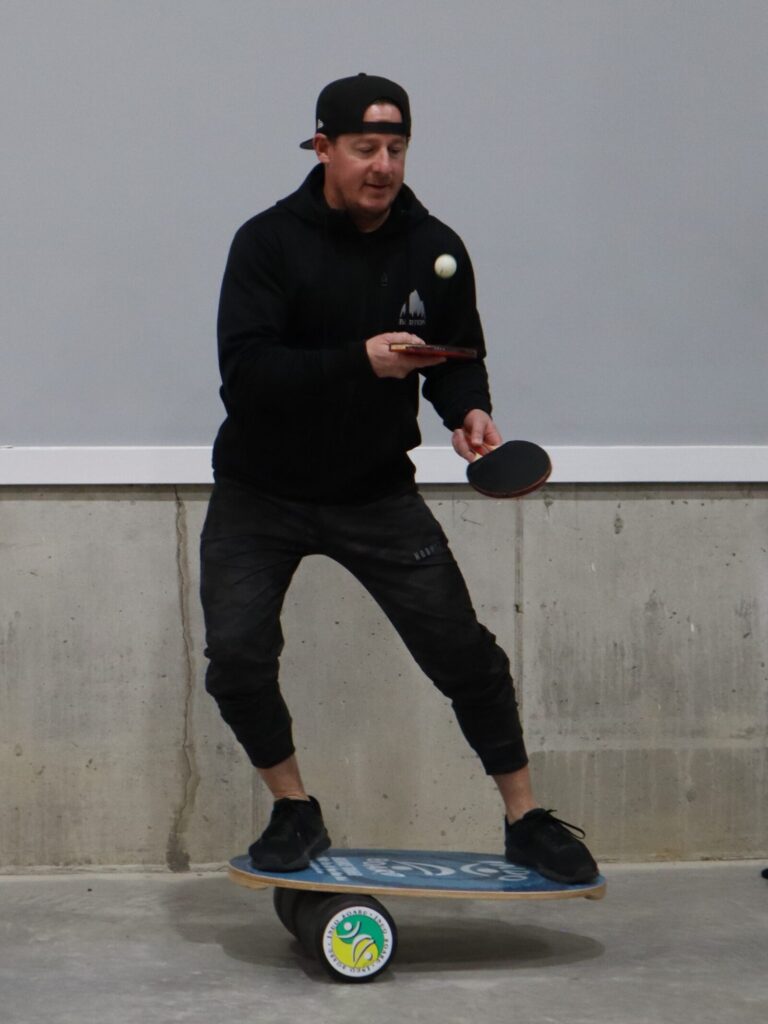
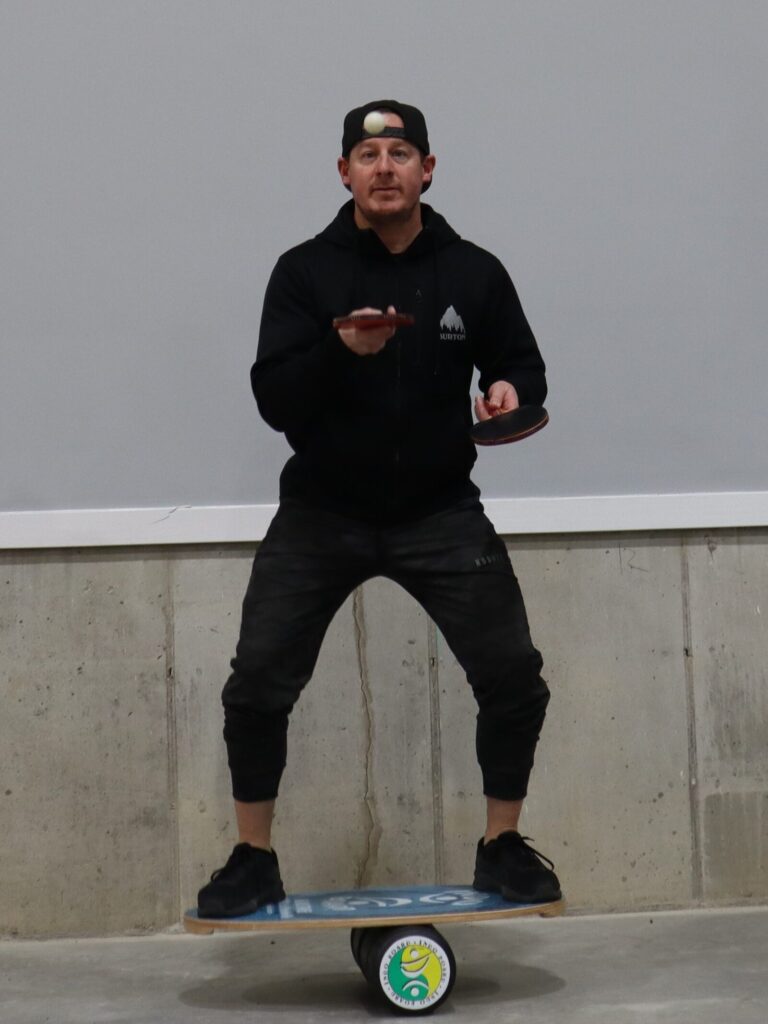
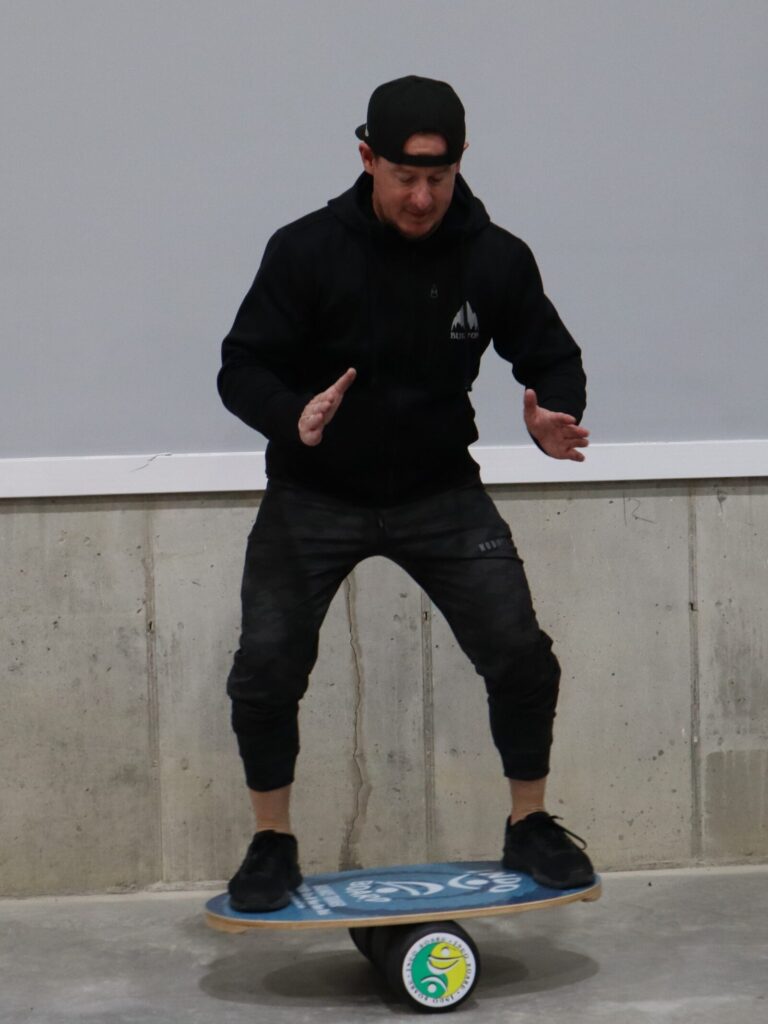
- Some of the balance exercises I incorporate into my routine are very basic like standing on one leg to more advanced like throwing a weighted ball while on a balance board. Generally, my progression is a timed one-legged balance on a flat floor (eyes open then closed). Then, a timed one-legged balance on a pillow or a special balance pad. Again, eyes open then eyes closed. If you have access to a cool Bosu ball where one side is flat and the other side is shaped like an exercise ball then you can try to progress to that after the pillow.
- Finally, I get out my balance board. For me, I use an Indo Board. My Mom has a picture of me on an Indo Board when I was 6 years-old in Colorado when we visited my cousins. At that time (we’ll say ummm…the early 80’s), my cousin Bruce was one of the first professional snowboarders sponsored by Burton. He had a bunch of balance trainers at his house and one of these was an Indo Board. Evidently, I spent the whole vacation on his Indo Board. I’ve been hooked since. Forewarning, they are dangerous! Do not think you can just jump on one and start riding it. However, they are an exceptional modality for balance training. Generally, I start by just riding the Indo Board. Then, I move into performing distracting activities while balancing on the board like throwing a tennis ball against a wall and catching it or bouncing a ping pong ball on a paddle. If my son Tyler is working on his balance we will throw a tennis ball or a weighted ball back and forth.
Now that’s a lot to digest for just getting ready to downhill snow ski or snowboard. However, like I mentioned before, my goal is not to get ready for the Olympics with this program. I’m just trying to build a foundation of “ski shape” to reduce my chances of injury and to take full advantage of the hours I have on the slopes. I hope this article gets your blood pumping for some winter downhill snow skiing and snowboarding. Stay safe and see you on the slopes!
